
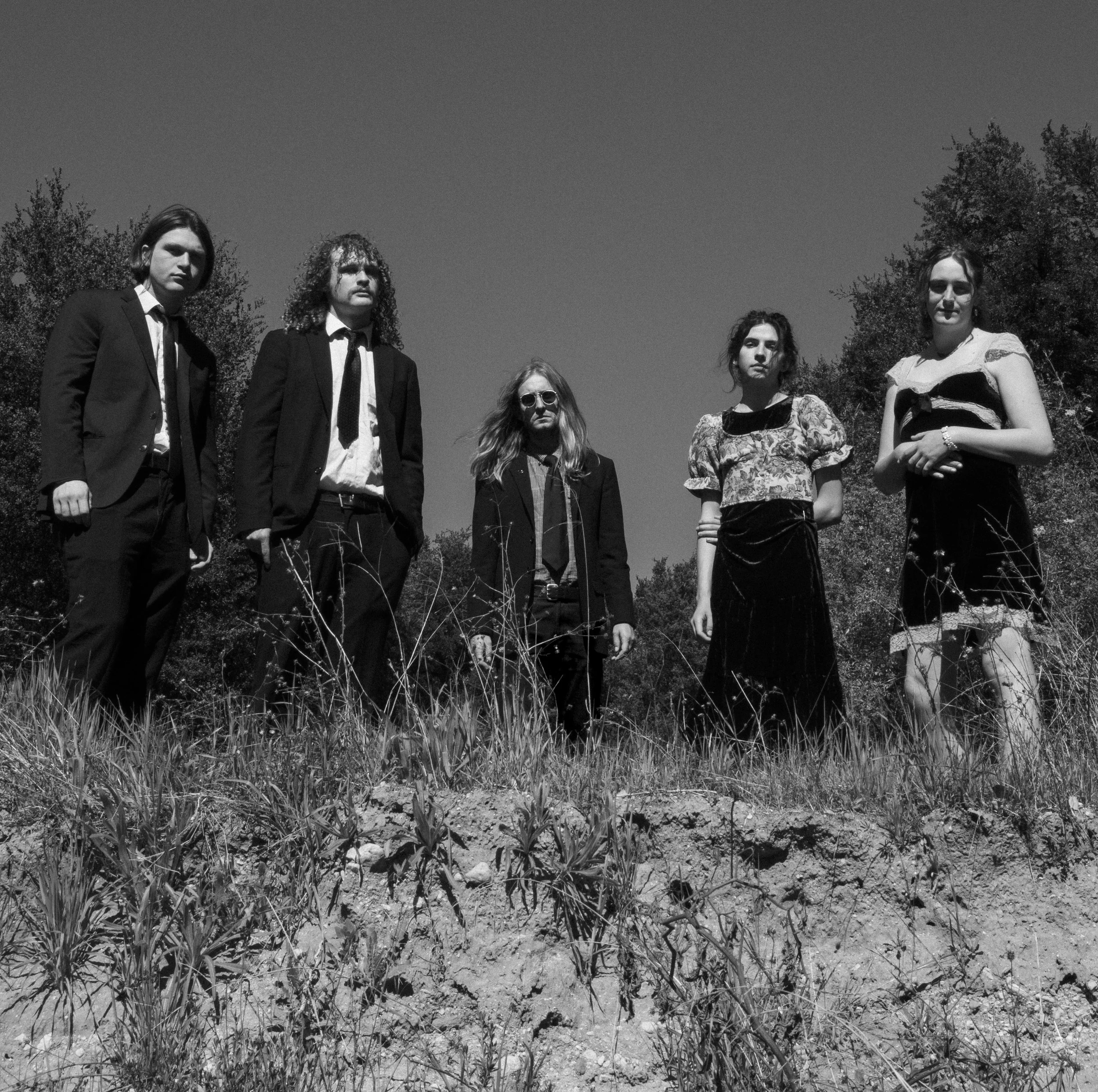
Images courtesy of Shearling.
this interview took place in September, 2025.
A few months ago, a friend sent me Shearling’s Motherfucker I am both “Amen” and “Hallelujah” …, a song unlike anything I’d ever heard.
At one hour, two minutes, and twenty seconds, the Los Angeles band’s debut is a non-stop amalgamation of noisy breakdowns that blend into harrowing instrumentals, and the howling, and screaming of lyrics that address themes of sexuality and religious trauma. It’s a confronting journey of unfiltered emotions from start to finish. During that first listen I couldn’t turn away, unable to completely comprehend what was going on nor understand how it was possible, all I knew was that I liked what I was hearing.
Even though I was already familiar with Alex Kent and Silvie Simmons’ previous band, Sprain, there was still an allure of mystery radiating around Shearling and the release. There was something else happening, it was different to what they had done before and anything I have heard in the past. Something felt unanswered, and that was echoed by the ambiguity of the album cover that doesn’t feature any words, just a graphic drawing of a horse on the ground with its asshole in complete view.
Still wanting answers, months on from the May release, I called Alex in the days before the band headed to Europe for their first international tour to talk about the breakup of Sprain, how Shearling began, and everything to do with Motherfucker I am Both “Amen” and “Hallelujah” ….
You’re about to leave for the Europe tour. How are you feeling about it?
I’m ready to go, a little stressed but we’ll make do and figure it out.
Did you tour Europe with Sprain?
We tried a few times, but we had one fall through because of Covid in 2020. We had one that was supposed to happen in 2023 but the band had broken up, so it never came into fruition.
How did Shearling come to life after the death of Sprain?
There was no way to keep doing Sprain because there was some circumstantial stuff that led to it being impossible to continue and Shearling was what we decided to do instead of Sprain, as a continuation, even though it is a much smaller project.
Does it feel like a different project musically?
Inevitably a little bit but I’d say the pathos and the goals are the same. The sound isn’t that different even though the Shearling record is a lot different from the Sprain stuff but I think there’s enough crossover so you can see it’s a quasi-spiritual continuation.
What is that pathos that you want to bring to Shearling?
It’s unfiltered emotionally and a big commitment to at least what the music is very intense and loud, not compromising no matter what.
How did the idea come up to do Motherfucker, I am Both: "Amen" and "Hallelujah"...?
Sylvie and I both put in a lot of the heavy lifting on the writing of that song. We were gearing up to do it with Sprain, then when the band broke up, we didn’t want to get rid of the progress we’d made but at the same time as we grew as people and artists. It started to take on a new form, new shape and in a way, it got a little bit out of control. The initial idea was for it to be a song on a record we were making but it became clear through the recording and mixing process it was too much to ask and would be detrimental to the listening experience if it was on a record as a song instead of it being its own record.
Was it already an hour long when you made that decision?
Yeah, it was getting up there. We kept making jokes because it kept getting longer. We ended up trimming it down a bit because it was closer to an hour and fifteen minutes.
Where does the song writing process even start for a song of that length?
It just kind of happens over time, we didn’t sit down and say ‘Alright, time to write the one-hour song.’ I have found that if there is a lot of conscientious decision making before the compositional process it can be detrimental to writing, it’s very difficult to fulfil a concept if it’s established before we try. I find it more satisfying and rewarding to see what happens in improvisational settings and embracing mistakes. That ends up being more rewarding and the better material as opposed to setting out to do something. It’s a collection of mistakes that we then carefully and intentionally arrange in a way that make sense to us as a song. As well as providing a backdrop to the narrative arc of what the lyrics are.
Yeah, how does piecing together lyrics work for a song like this.
A lot of the time the lyrics were coming after the music and other times the music was getting informed by the lyrics. They kind of lived symbiotically alongside one another and equally informed what we’d do next.
Were the lyrics prewritten or were they mostly improvised.
I had some of those ideas when we used to play with Sprain, the more theatrical vocal cues, but when Sprain broke up, I cleaned the slate, I got rid of all my notebooks, notes on my phone and started making new ones. It was all new stuff; I’d say forty percent of them were written and ready to go by the time the song was really flushed out and so I had some work to do and that’s when I really homed in and only worked on writing as opposed to the way the music was going to go.
When Sprain ended did you see that as a chapter closing?
No, not really. I didn’t want it to end. When it broke up, Sylvie and I got together that day, we didn’t have the name Shearling, we didn’t know what we were going to do, but we knew we were going to do something that was going to be in the same vein.
Your lyrics are very personal and performed in such elaborate ways. Do you find the performance of your music to be a therapeutic release?
There is always a certain degree on making it hyperbolised, there is a lot more of an emphasis on being extreme with the emotions because its theatrical, its art, music, and it’s agrological. It comes from an honest place, and it’s just filtered through this giant amplifier.
The theatrical element is something that stands out quite a lot. Someone uploaded a live set that you guys did, and it was quite a theatrical performance. How is the experience of performing this song live?
I mean the live performances are never theatrical in the way that we make these decisions before the show, like that I’m going to smash the guitar.
Or get undressed…
Oh yeah that one, okay so here’s how we are going to categorise the shows, the one where I get undressed, the one where I smash the guitar, the one where we yell at the sound guy [laughs]. Yeah, none of that stuff was planned, it just kind of happens in the moment. Those things are theatrical; they're more like performance than they are music. We don’t get together and be like ‘How crazy will it be if Alex throws a tantrum.’ Performing is a good way to be completely naked on stage, not literally, although I did that, but I mean emotionally, because it seems like a safe space to express things in any way with less consequence if you were in a more vulnerable setting. You can get up there and yell and do things that would otherwise be unacceptable or disturbing in a public scenario but because it exists within the context of a performance you’re allowed to. I sometimes feel like that’s the only place I ever feel you can be completely honest. I don’t filter that out, I get mad, and stuff happens, but I think that’s rewarding for people because it’s not emotionally rehearsed, it feels raw. Well, that’s why I appreciate it when I see it.
Yeah, it feels like you are being completely yourself and not hiding anything in that moment.
Yeah, and, I feel like the way the shows go and the mood there are all these uncontrollable variables that create this network of possibilities in the context of a single show, and I just allow myself to be dictated by that regardless of all these factors. Then when the show is over I’ll have to reign it in and come back down to earth and be a nice guy.
Do you think the way you’ve performed on stage has changed since you started performing Motherfucker live because it is such an intense experience?
I guess so, but we also haven’t performed it live that much. We’ve played a pretty minimal number of shows because we haven’t been on tour yet and we don’t play locally as much as Sprain used to. It is intense, but it doesn’t feel super worth doing if it is super chopped up. It is definitely draining and tiring.
You guys are very well rehearsed with the song, listening to the live show, the song is very similar to how it sounds.
Yeah, we are really disciplined with rehearsal, twice a week, multiple hours at least. We’re pretty focused and there is a lot of improvisation, that’s one thing that keeps it interesting too, because right now to a certain degree we are only playing this song or maybe sections of this song. I’m not going to say it’s getting boring, but for me I’m like “I can’t wait until this is over so I can get to a part I enjoy a bit more.” It’s not that I have favourites, but I try to apply myself to each part as much as I can. There is a lot of improvisation which keeps it really fresh and exciting. Even though the conduction and improvisation happens in the same parts of the song they’re always going to be a little bit different which is fun and keeps it refreshing for us to play.
Totally, I could imagine.
Also, if you start that and shit starts to fall apart it’s like okay, we’re fucked, we’ve committed to a really long time. I also think that’s something that almost needs to get rehearsed as much as the music itself, just committing and being in the headspace to play a song that long. When it’s gone bad, it’s just a slog to get through, it’s like ‘Now we’ve got to do this for another 45 minutes.’
How many European dates are you doing?
Twenty one, I think.
How are you feeling about playing the song that many times?
Great. I like playing it a lot. But also, we have a couple of different versions of it and some other material we will be playing too. We’ve never been a band who has a setlist and plays the setlist the same way every night. I think it would be totally miserable to do that as a performer, we’ve got a pretty decent repertoire of material we are going to shake up and mix in with Motherfucker every night. I doubt we will play the way it is on the record even once. The song feels so modular, it can be chopped up and rearranged in so many different ways that I think that’s what we’re going to do, make each night a little bit special.
To wrap this up, what’s the backstory behind the album cover?
Oh yeah, well. We knew it had to be horse themed and I wish I had a better story for it, but I stumbled across that drawing. It’s from a series of drawings from this sixteenth or seventeenth century Dutch artist and when I saw it, I was like that’s the album cover, no doubt about it. It just feels like that horse has this ambiguity about it. The actions of the horse are ambiguous, like is it dead or is it alive rolling around, why is its asshole visible. I feel like it has to do with a lot of the themes, sexuality, unnoble, ambiguity, it happens to be the symbol of the record. It is the best album cover I have ever seen in my life without question.
It works well and it stands out when you look at it. It's like ‘holy shit.’
Yeah, I’m surprised at how many people had an adverse reaction to it. It’s a drawing it’s not like it’s some real gore or something really fucked up. People were like ‘I’m not buying that, what if someone came into my house and saw that.’ If I came into your house and saw that I would be think you are fucking awesome but if I came to your house and saw an Arctic Monkeys record, I would get the fuck out of there. You know what I’m saying?
Man, I agree, I don’t want to see that Arctic Monkeys record either.
You wouldn’t hang out with someone like that. If you had the Motherfucker record out on display and someone came over to your house and they didn’t want to be friends with you then you wouldn’t want to be friends with that person. It’s a good way to filter out anyone who isn’t worth being your friend if they don’t like that album cover [laughs].