
Cate Le Bon on ‘Michelangelo Dying’
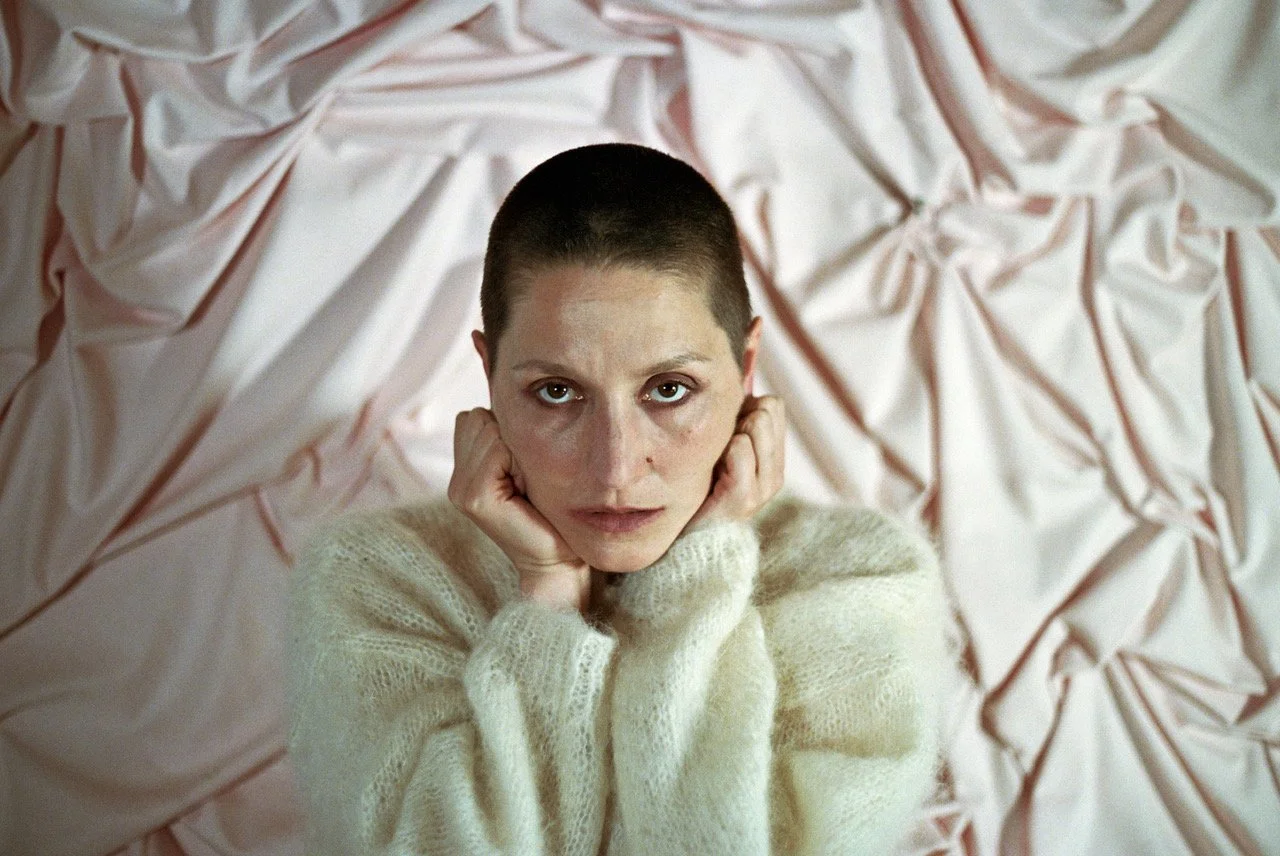
Portrait by H. Hawkline.
It’s a tale as old as time - artist experiences heartache, artist goes MIA for a little while, artist then returns with one of, if not, their best body of work to show for it.
Cate Le Bon is first to admit that she did not set out to make a record about heartache, in fact she had envisioned something entirely different for what would become her seventh studio album.
It’s Tuesday, just past 7pm in Sydney when Cate joins the call from her home in Cardiff, Wales. We exchange a quick hello before she apologises for her dog, Mila, barking somewhere in the background. Whether it’s the lightness of the moment or my apparent weakness for a Welsh accent, I’m immediately put at ease. And so we begin tracing the path of Michelangelo Dying - the record she never intended to make, but would ultimately become the vessel for her healing in the aftermath of a long-term relationship breaking down. It’s emotive, while at times haunting in its soundscape, with melodic vocals that glide through the fractured states of loss in self and in love.
Cate Le Bon will be playing at the Sydney Opera House on May 31st as part of the Vivid LIVE showcase, as well as a national tour (presented by Mistletone) listed below:
Thu May 28 - Fremantle: Arrival @ Naval Store w No Bride
Sun May 31 - Sydney: Vivid Live @ Sydney Opera House Joan Sutherland Theatre w Cass McCombs
Tue June 2 - Brisbane: Open Season @ Princess Theatre w Hana Stretton
Wed June 3 - Melbourne: Rising @ Melbourne Town Hall w Georgia Knight
What does the title Michelangelo Dying mean to you?
I suppose it speaks to experiencing love and heartache through art. Not only the universal experience of it, but how it’s experienced and processed differently. I think there is a kind of tongue-in-cheek grandiosity to it too, because there is something quite ridiculous and overt about heartache.
It’s quite a clever title for this body of work. I’m curious, did you feel much resistance to making a record about such a hard time?
I didn’t really want to make a record about heartache because it feels like such a cliche, and yet it was the thing that I needed to experience. To be able to put something down, and to, I suppose, do the hard work of looking at it and trying to see it as it really is and not how I wanted it to be. It just became the thing that I always ended up leaning towards, and so, I just allowed myself to, rather than constantly battling it and making something that wasn’t authentic to what I was feeling at the time.
That makes sense to me. I also think there is a level of resistance that we all feel towards heartache, which more than anything probably has to do with the fact that it is a fleeting emotion. I mean, avoiding feeling heartache is the only thing that keeps it alive, right?
Yeah, it's reeling against its own impermanence, which is quite a hard place to be in. There’s like a fantastical, dramatical form that takes on that feeds its own narrative, and you have to try and get beyond that point, for I guess, the radical acceptance to kick in.
Ah yes, radical acceptance. My therapist is quite often encouraging me to practice that.
(laughs) mhmm.
How do you find playing these songs now, after, I can assume having moved through a lot of that heartache. Has your relationship to them changed?
Yeah, I mean, it did really serve as this kind of cathartic experience to allow things to just come up and not question them too much, just trust that they were real. So to get all these feelings out, be it, you know, lyrically or the kind of emotion in the arrangements and parts. To now be looking at those thoughts and feelings, from the outside with a calmer head after being able to have put them down, I have come to understand them in a different way. But then there is a massive difference from when you’re making the record, because it’s all very inward facing and you’re working with people in a close knit group that you trust, to when it’s done, and all of a sudden you’re having to face people you’ve never met and perform for them, and you want it to be real even if it doesn’t feel like it, because you want to feel it and you want them to feel that it’s real. I really enjoy the meeting of those two things and how you come to understand something differently, while still being able to perform it outwardly and still really mean it. It’s a nice uncomfortable transition but I think there’s a clarity in that discomfort. It’s been a nice part of the healing for me.
I read that you moved around quite a bit while making the record. Do you feel as though the places you were in, physically speaking, influenced the final product?
Inevitably, you know, you’re influenced and things change because of where you are. But I think, this record especially, was an inescapable feeling that I was just carrying around with me, and I couldn’t finish the record until I had put all this shit down. So it did serve as this kind of vehicle of healing. The record wasn’t done until I’d really gone, oh, that’s as much as I can put down, it was the end to this weird tango. I think taking it to Joshua Tree, where a lot of the heart ache was staged in my mind, and finishing it there was really important, because it was probably the only place it could be finished.
I find it interesting how a place can come to exist as that. You collaborated with some pretty incredible artists in and around this record. Do you find collaborating to be important to you?
Of course, I mean everyone who was involved in the record was someone that I felt an emotional attachment to. You know, Samur Khouja, who engineers and co-producers with me, is someone that allows me to be vulnerable and get completely lost, because I know he’s got his eye on me. Very similarly, Euan Hinshelwood plays the saxophones, which I came to depend a lot on, you know, when I couldn’t sing about something, the saxophone kind of took the sentiment and expanded it or acted as a very specific emotion in the song. Then, you know, collaborating with JohnCale meant so much to me as an artist, and I’d gotten to know him after playing shows with him, and Annie Clark who is there as St. Vincent, but was and continues to be an incredible friend to me throughout a period of disorientating heartache. She was a real anchor for me.
That’s really beautiful - we all need our anchors. Does this emotional attachment that you speak of, with the artists that have collaborated on your work, also feel necessary when you’re the one collaborating or producing for someone else?
I mean, I worked with St. Vincent on her record and I think that was born from this kind of honesty that we have, and that she needed. It was a kind of honesty which exists in friendship that is restorative and not reductive, where there is a real function to it, and it’s something that I’ve also been lucky to have from her. Similarly with Jeff Tweedy, but then there are bands I've worked with that I haven’t really had a relationship with before, but I have just really chimed with. I will only work with people if something really captures me, because you know, I love producing, but I don’t want to be a producer. So when I do, do it, it’s because I can’t not do it.
You know, Horsegirl, I'd never met them before, but god, they were just so special. Dry Cleaning, the same, we’d met once, but there was just something in the demos that they sent me, that I couldn’t stop thinking about, as well as and the conversations that we had before we even agreed to work together. But it is emotional, you know, you're making something that you or they have put so much time and love into that means everything. So, there should be an emotional connection within it all; it’s what it deserves. So, yeah, I guess I do try to only do things that provoke that kind of emotional reaction in me.
I’m interested to know if there is a record that you believe is perfectly produced?
That would be Faust IV, for me. I think it is perfect. I make reference to it every single time I am working on a record, whether it’s my own or on someone else’s. I mean, sonically it’s beautiful and it’s tactile and it’s luscious, and there’s friction, and the sensibility of it; It is playful, yet so beautiful. It has always been the one for me, ever since I heard it, nothing beats it (laughs).
I believe you! I’d love to wrap this up by asking about who you are outside all of this? I mean we’ve spoken about Cate the artist and Cate the occasional producer. What do you do that makes you happy?
Umm, I do it all the time, so it’s hard to say! But I recently allowed myself the joy of getting a little dog and it’s something that I have resisted for years, and it has just changed everything for me.
Why did you resist it?
Because, well, I think I’m scared of loving something so much… And also just of the mind that I work so much, but, you know, I want to slow down, I don’t want to travel so much. Now I have something that really makes me not want to, or if I am going to go away, it better be good because I have to leave this little dog!