Words by Hayley Biddulph.
Relentless relationships to home, navigating grief through writing, and how sometimes, she simply “paints for the sake of paint.” This is Zoe Grey.
I’m two hours south of Sydney, in a little town called Berrima. Apparently Australian rock singer Jimmy Barnes lives here. It’s winter. I’m wearing a Macpac puffer jacket, sheep’s wool leg warmers from Chile, and I wish I could stay here forever. Native gum trees. Local honey. Rugs turned into handbags. Chopped fire wood. Sandstone buildings. Coffee beans. Sulphur-crested Cockatoos. Crimson Rosellas. A lolly shop called ‘Lolly Swagman.’ Lemon butter, chilli jam, local Berrima jam – sold in a pack of three – at a good price.
If you want to get inspired, get out of the city. Nothing is more invigorating than places where artists, writers and musicians choose to live. A lot of creatives congregate in regional southern areas of Australia, like Berrima, and the broader Southern Highlands, as well as places like the NSW South Coast, the Blue Mountains, the Victorian Surf Coast, and parts of Tasmania. There are distinct four-seasons here. The trees turn golden. It creates a sort of focus. The bushland is rugged, open, and the birds are loud. There’s a type of community in small Australian towns that’s palpable.
I stumbled into one of the galleries in the Southern Highlands. Zoe Grey’s abstract landscape paintings haven’t left my mind since. Emotionally packed, and beautiful compositionally. I called her up, and it turns out Zoe Grey is an avid punk music fan, but also the most down to earth, calm and kindest person I’ve talked to for a while. She’s a surfer, and a listener, but above all, she’s an artist.
I went to the Southern Highlands with some friends. I saw your work in the Michael Reid Gallery, I was like, ‘Oh my god, who is that?’
I'm glad you stumbled across it and enjoyed it. That's nice.
What are you up to today in your studio?
I've been framing today.
Oh, cool. You do your own frames?
I've done it for the last few years. Over the last ten days or so I’ve been flat out doing that.
So, you grew up in a town of a hundred and fifty two people, on an organic beef farm – can you tell me about that experience in itself? It sounds like a scene from a movie, you know, it sounds so wild and awesome.
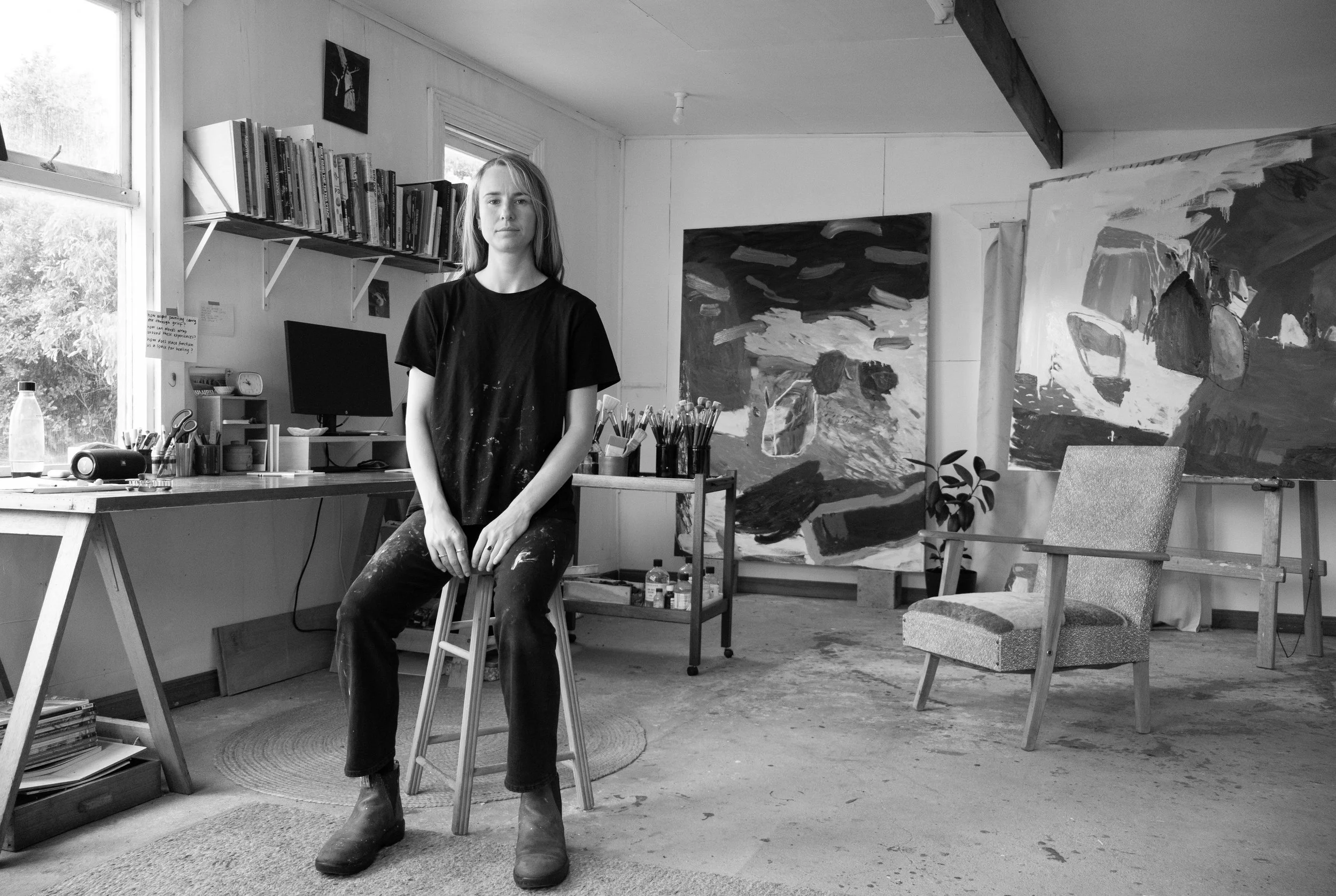
I grew up in Marrawah. It's on the far north west coast of Tasmania. I’m back living there now. That's where I am at the moment. It's super remote. Very rugged. One pub, a general store. Really, really remote. The farm that I grew up on is along the coast. Yeah, I’m living quite close to, and with the weather. Wind and water and swell and cold. It was that informative way that I grew up. It certainly informs a lot of my work, having built my own place just recently, living back here on the coast.
So you've built your own place back where you grew up on the farm?
Yeah, with my brother.
You built a house with your brother, by hand? That’s awesome.
Yeah, he's a builder and I was just an enthusiastic apprentice. I love living here. I've lived away, but this is home for me.
I got chills when you just said that. I don't know why. It's like it’s so right for you or something, you know? To live there.
It's nice. I'm all packed from Hobart now. I did have a studio there. Now I walk to my studio across a path. Living here, I can surf, walk, and obviously make art. Here, it’s really easy to get that balance of living closely with the environment, more than other places I’ve been. There are things you sacrifice for that; socialising and I can’t go to exhibitions. What I get in exchange for that is powerful for me at the moment.
Now that your art studio is in the heart of the place you paint, do you feel more aligned?
Yeah, because so much of my work is about this place, notions of home and experience of place and experience of the landscape. For so many years, my work has been so much about Marrawah and my kind of relationship to it. I was always exploring those themes and ideas through a slight lens of distance, you know, living away and sort of using that to connect to it. My practice was a way to connect to home and engage with it. Now, it's interesting being back here full-time and seeing how my work is going to shift in really subtle ways because there's no longer that distance there. It's really like being immersed in it and present with it. I’m intrigued to see how my practice will ebb and flow with that.
Yeah, letting go of that physical distance to the place you’re representing is an interesting concept. Do you notice parts of your art changing, or is it too soon to tell?
Yeah, I mean, I think so. There's more of an immediacy to responding in the landscape. And, I guess it plays a slightly different role now. You know, it's still a way for me to engage with, and explore and unpack my relationship to this place. But there's not that sort of necessity to feel close to it because I'm here, in it.
I think it’ll be interesting to see how it evolves. While we're on the topic of creating art in a particular place – I saw you did some residencies, one of them being in the Lofoten Islands. That place is magic, did you feel drawn to paint that environment?
For me, I find residencies such a good way to be experimental, playful and devote time to being outside of your comfort zone. I have made work about other places when I've been on residencies. Funnily enough, a lot of the work I made in Norway was about home. In funny ways as well. I'm very intrigued with engaging with other places, and then also how you can build connections to new places through immersive experiences, through making, engaging and painting.
I noticed that other than painting, you also do collage, and create really cool ceramic rocks – it literally looks like your canvas has jumped into a tangible, three-dimensional form. Are you still doing ceramics, or collages? Or will you include those practices in your upcoming show, Out Of The Blue at Despard Gallery?
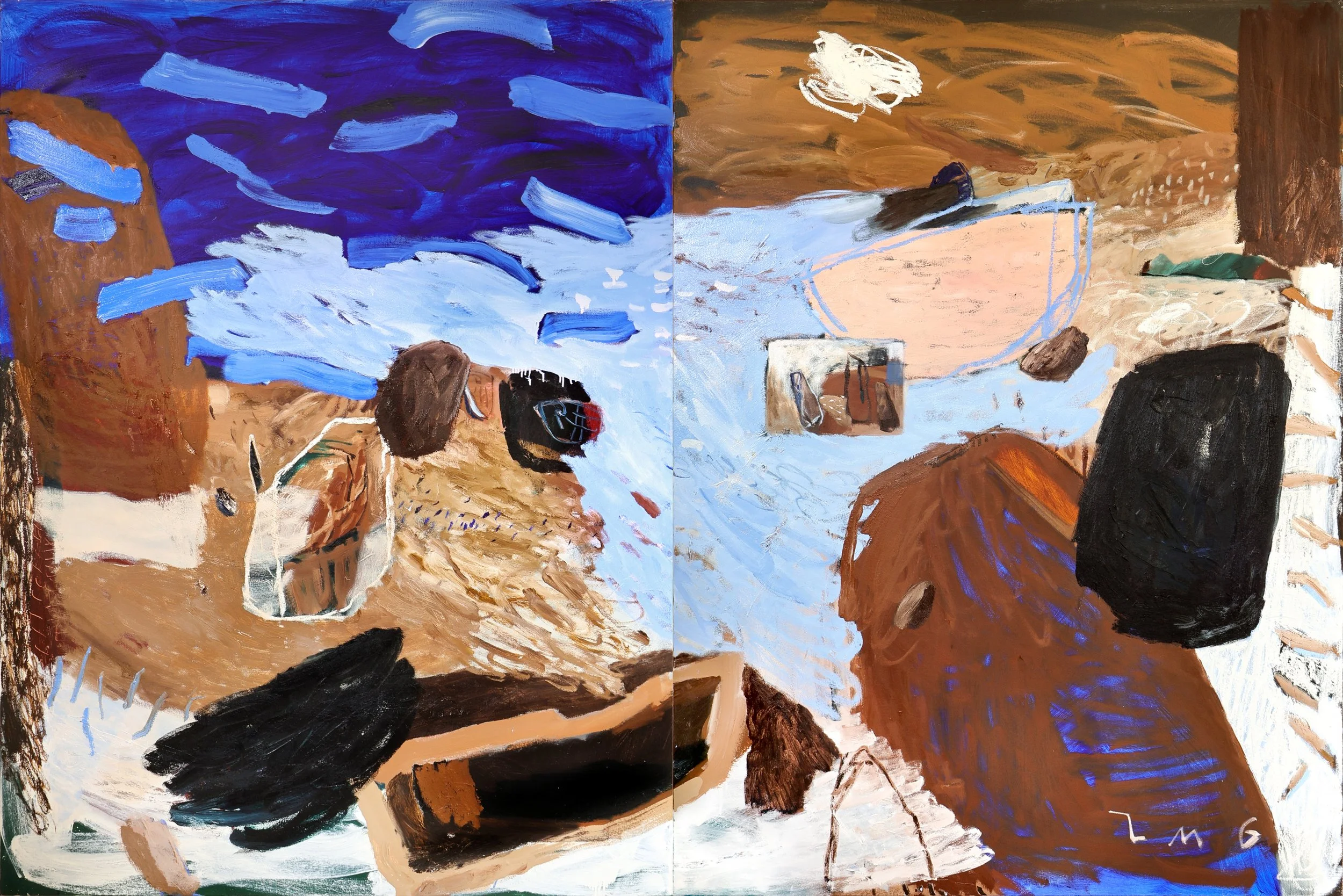
For this show, I haven't done any ceramics. But I made those rocks for my last show, and I've done a bit of work with ceramics, but so novice and in more of a playful, experimental way. That's certainly something I'll circle back to. Drawing is a big part of my practice, and collage. Painting is where my heart is, and everything circles around that. In this show I've got coming up, there's some works that include text. That's new. I think writing is a big part of my practice, and it's always been happening on a studio level, but I haven't really shown work with text before. It’s exciting, and I’m eager to see how it's received.
With your writing, are you journaling as a sort of outlet?
Yeah, definitely journal processing. I write a lot of poems and short form passages in my visual diary that I've kept for the last ten years or so. They're often filled with as many kinds of writing, musings and recordings of memories, lines and poems as there are just drawings.
Do you show anyone those visual diaries, or prefer to keep it close?
Not really. But you know when people have big survey exhibitions of their fifty year career and they'll have their journals displayed and you can put the white gloves on and look through them? Sometimes I think, imagine if that happens for me. My journal is such an intimate, beautiful thing. It's pretty pure and there's a lot of honesty and integrity in it because it's never intended to be shown. It's pretty much a stream of consciousness. There's so many spelling errors. There's probably things that I could only decipher in there.
Do your recent paintings feature your poems?
There's some words that have been plucked from poems that I've written over the past year and a half. There are lines plugged from that. The text is accompanied by drawing, or really naive, playful paintings of objects of significance. They're on unstretched linen, so they're quite fragile and formally quite different to my traditional paintings, but intended to be alongside work that is much more traditional of mine. They're titled as flags, hopefully like clues, stories and hints into what the show is about. The text is there as a clue.
That's really nice. I love writing as well, it’s a good way to put down ideas. Alongside writing, are you a big music person? Now that you’re living in Marrawah, a bit further from gigs and things in Tassie, how do you feel about that?
Yeah, music's always been important to me and I use it quite intentionally in the studio. Particularly at different stages of a painting. I draw on different kinds of music or podcasts when I'm doing something a bit more subtle. Working on a big piece in the early stages, I like to draw on a lot of punk or something fast and loud in my ears to complement that energy that I need. My brother's in a band. I think 90% of my music taste came from having an older brother who had really cool punk rock CDs that I would listen to. That's definitely shaped what I listen to.
Wow. Is his band punk rock as well?
Yeah, hardcore-ish. They play in Hobart and play lots of house shows.
It's funny. I don't picture you listening to hardcore punk music. You’re so chill and down to earth.
That's funny. Yeah, I've always felt that kind of music deeply. Around the house I certainly listen to my fair share of soft Australian indie. But when I'm really actively listening, I usually draw on something a little more, hard and fast.
I do that too when I paint, it helps a lot. It gives you that energy you need.
Fully, I think it's an energy thing. I love podcasts as well. So when there's something else going on that's a bit more mundane, like framing, for example, where I'm just going through the motions of structurally building something. Or for the morning, when I first get into the studio and have a coffee; do some writing, looking, reading and thinking, I listen to soft music for that type of day.
What does your day sort of look like?
If I can get in a surf during the day, that's a win. Often yoga first thing in the morning. If I can move my body before I get into the studio, I feel a step ahead. My mind is firing the best from around 8am to 11am. Ideally, I’d get into the studio and spend the first bit thinking, drawing, looking, pondering, reading, writing. Just kind of ‘brain active.’ That's when ideas happen, reflections and things kind of click for me. While I've still got that energy, I jump into some painting, and then, walk back home for lunch in the fresh air. That’s a good little middle-of-the-day thing. Arvo I admit, if I'm feeling like that creative energy is a bit depleted for me, or just energy in general, I’m organising shit; emails, organising materials or freight, or framing. The practical sides of running a business, I guess.
You forget you're running a business as well as making art.
Yeah, it is a lot. Doing your taxes… I’ve sort of learned over the years of doing this: if I can structure a day that way, I'm going to get the most out of it. I treat it as a bit of a nine to five, five days a week kind of thing. It just depends. For the last three weeks, I haven't had a day off. I'll probably have a couple of weeks off after the show. But when I'm in the normalcy of it, I like working through the day and having a few days off on the weekend when other people do. I've never been a night worker at all.
When you're sitting and thinking, are you looking at other artists or musicians for inspiration?
Yeah, I've got a bunch of really good collections of artist books to look through visually. I might be doing little drawings of compositional sketches or playing with ideas to figure out what I'm going to paint. There's a bunch of Australian abstract landscape painters that I'm super inspired by. Mostly painters, but also, a lot more recently, I’m looking through books of poetry in the morning.
If you had to have breakfast – or dinner with an abstract landscape painter, who would you want to chat with?
Dead or alive?
Uh, let's go alive.
Maybe Elisabeth Cummings?
No way, I literally have an Elisabeth Cummings book next to me right now.
I just feel like she's amazing. What an amazing person to have a conversation with. Someone with such a wealth of experience, knowledge, and curiosity. And with a woman who's that old, that accomplished, and still so engaged. I love looking up to women in their 60s and 70s and 80s who are still making incredible work, pushing themselves and their boundaries. It’s so inspiring to me. Because then you think, ‘fuck, I've got fifty more years of my career.’ Yeah, isn't that exciting? It's wild. I think we forget that.
So true. We do forget that. We forget those wins, it’s really funny.
Definitely. I don't know how you get better at trying to take moments to recognise it. Maybe just practicing it.
Your compositions are perfect to me – are you making them up intuitively, or are you planning them before you put anything on the canvas?
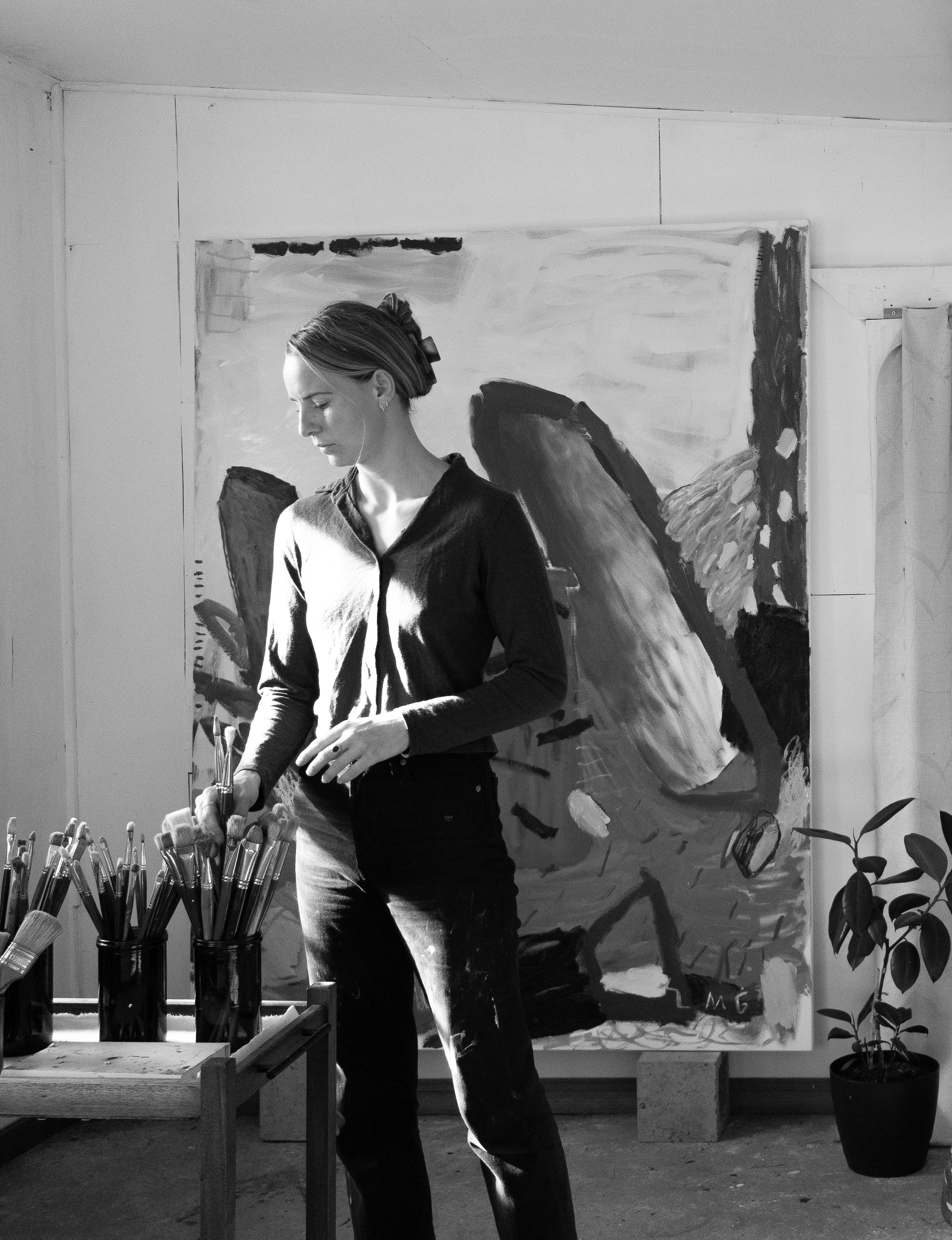
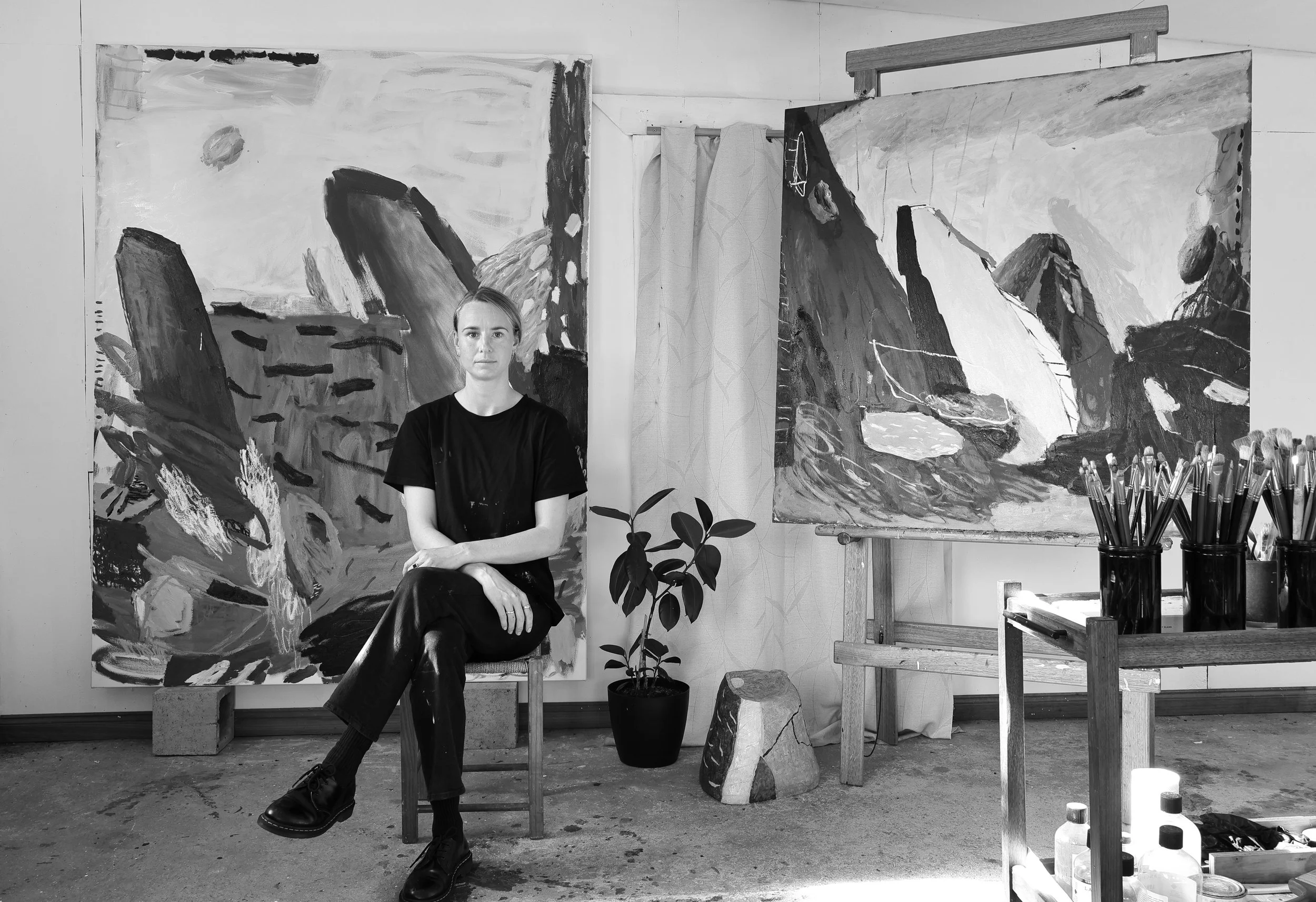
That’s so lovely. A bit of both. Often a work will begin with a small compositional study, which might just be in my journal; a few shapes, or a line that’s describing the weather or something that I want to base the palette off or whatever. There'll be a few little touch points. Usually for a painting, some general kind of composition, maybe a palette and essence – a sort of conceptual link. But so much of the painting comes from the process. I do work quite intuitively, so I’ll kind of start with that base. When I'm painting, I'm painting from memory or familiarity. I don't really use photographs of things. So there's that kind of abstraction of memory, but also so much of it is putting down a mark and a colour, and then responding to that mark and colour. Or erasing that, or adding this in. So it's just this constant kind of puzzle of responding to what's come before, and trying to listen to how the colours and the forms are speaking to each other, and when they need to be louder or quieter. There's a starting point, but it is different by the time I get to the end. It has its own life through that process – different directions that I don't plan. You kind of have these intentions, but so much of it just happens as you go along because you're having to listen to it.
You're noticeably a good listener. With your craft, you respond – does that mean you also have to back that response, and back yourself?
There's a bit of that as well. I think I'm definitely getting better at it. It's something that's come. I've been working in this way, with quite expressive marks and intuitive mark-making, and I've been sort of chasing that, and working on that for the best part of the last ten years.
How long have you been making art for?
I started making art more so when I was in my later teens, like seventeen or eighteen at college, year eleven and twelve. We call it college. I went to art school following that.
What art school did you go to?
I went to the University of Tasmania on Hunter Street. I guess art school was playful; a time of learning and growing lots towards my honours year. I feel like I can look back at how I'm working now, and see it beginning in that last honours year which I think was maybe 2018.
Is that when you found your distinctive style?
Yeah it sort of began then. I came to a place where I was working in that way. It hasn't been at all really intentional. I mean, it's intentional in that, I know what I'm desiring to do, or, you know, create. I know the kind of paintings I want to make, but there's certainly a confidence that I've developed in trusting my intuition, and also being comfortable with space in a work.
That is a hard one, isn't it? I struggle with space. And knowing when to stop. I don't want to stop, ever.
Yeah, I went on a residency in Finland quite a few years ago and I really focused on that for that month. It was also a residency where there wasn't any internet. We handed our phones in at the start of the month, meditated twice a day, and this idea of creating more space in my paintings was sort of happening alongside this experience of having all this space for focus. It was so amazing. It was called Arteles. I think about that residency a couple times a week; not having my phone, not on the internet, having a really strong meditation practice. It was also the tail-end of COVID so we couldn't even leave. There were twelve of us in the beautiful countryside of Finland. That residency was pretty pivotal for my practice, and also in seeing or appreciating the value of doing residencies for my work going forward.
Pivotal in terms of connecting you back to your practice, away from your phone and distractions?
Yeah, it definitely was good. There's some habits that I’ve taken out of that, or have reshaped my relationship to those things. Another great thing about it is, sometimes you'll be arriving at a residency and then a week later someone else will arrive, but then I’ll leave and they’ll leave. But this was twelve people arriving on the first day of the month and then all leaving on the 30th. Lifelong friendships with people around the world.
What's the Tassie, art/creative scene, like?
I think it's pretty amazing. Especially the Hobart art scene. The community is pretty tight, and my experience has been super supportive. A win for one is a win for all. That's how it felt for me. I've got really good friends who are at similar stages in our careers, and painters, and even people a lot older than me, some great mentors, and people who supported me. I think Tassie has quite a vibrant art scene. It can feel a little bit frustrating or lost down here. I feel like the Australian art scene can be very Sydney-centric. Trying to kind of infiltrate that can be tricky, I think. Tassie’s come a long way in terms of recognition. When I was a kid, people asked, ‘Tasmania, what is that place?’ And now you mention Tassie, and people will be like, ‘I went to Dark Mofo,’ or ‘I went to the east coast.’ People now say, ‘I've been there and I loved it,’ or ‘I really want to go there,’ whereas, when we were growing up, going to Nationals for surfing or whatever, the Goldy kids would say, ‘is there even a town in Tasmania?’
Yeah, people are jealous of Tassie.
The tables have really turned.
On my car, I literally have a, Keep Tassie Wild sticker. And I've been there once – No, I've been there twice. But I just love it there. I just love how the water's so cold, and there's no one on the beach. It just feels so remote, but there's this buzz of creativity and connection. I do love the Mona.
It’s got a lot going for it. I think for Tasmanians, or particularly for the artists and landscape painters – there's a big connection to the world and to the island people have here. And quite a strong sense of pride. Maybe that's not the right word, but we say we're from Tassie, not from Australia.
It does feel different from Australia in a way. It feels like its own community of creatives.
The other thing about Tasmania is, it's super freaking liberal dominated and it's full of rednecks and people who want, you know, the fish farms. So it's this interesting dichotomy. I mean, it's a classic kind of debate in Tassie, and there's two sides to it. But I think for me, growing up in the country, my parents were die-hard hippies and we grew up very green and open. It was definitely not the case for the town Marrawah. It's a farming community and it's rural. But I've got friends from high-school that I'm still super close with, and I know we have really different political views, but we have a shared history. I think growing up in a rural area, it's very easy to be out of your bubble, which I think is a healthy thing. You can be in these little worlds of socially progressive friends and that's so important as well, but it's pretty easy to access a lot of people who think differently.
I guess that's what makes the world an interesting place as well. I wanted to ask about the colours you choose, because they're such a standout for me with your paintings. Do you base your colours off recurring natural forms, like the Preminghana Mountain? Is that in your view of your new studio?
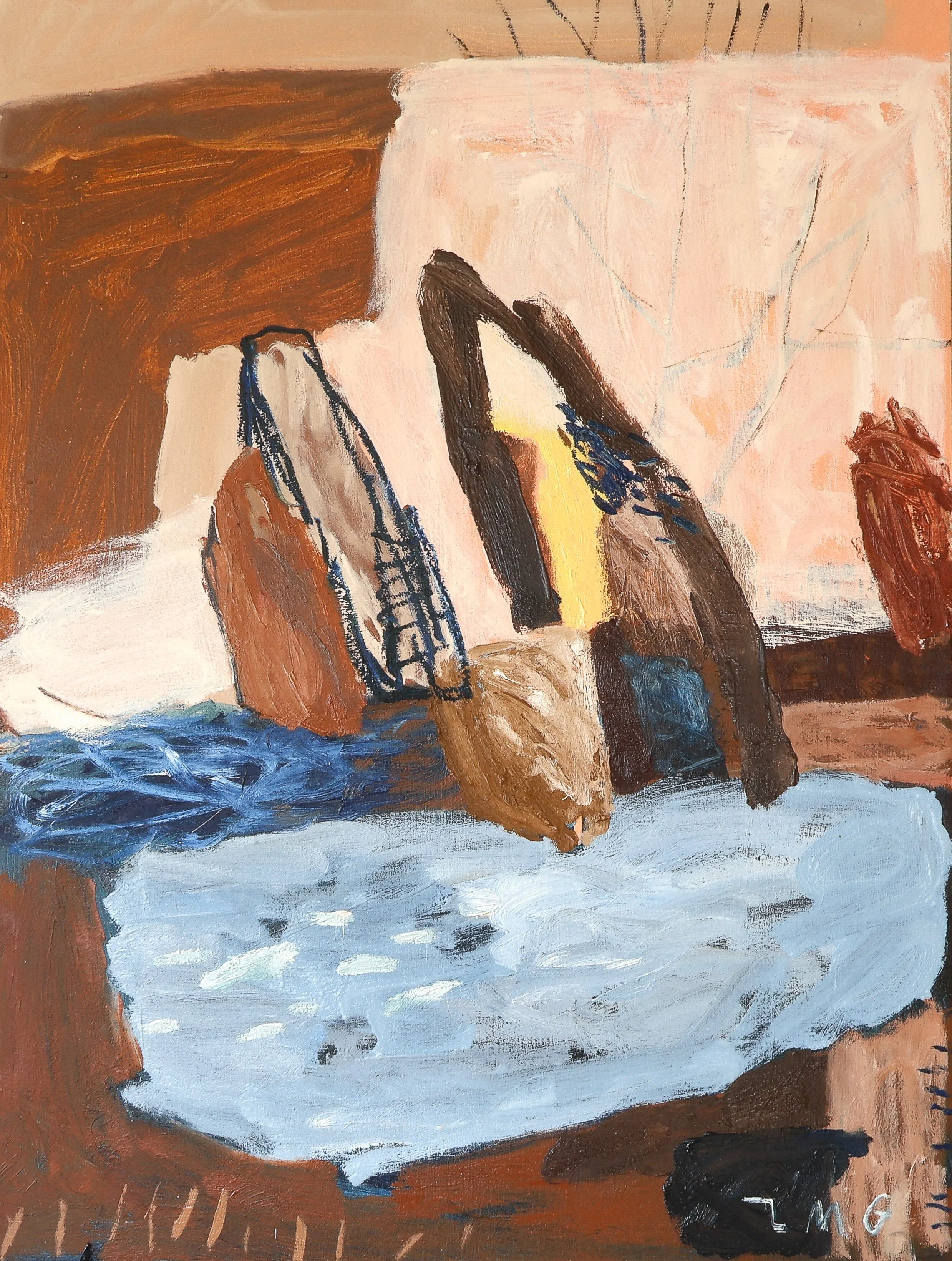
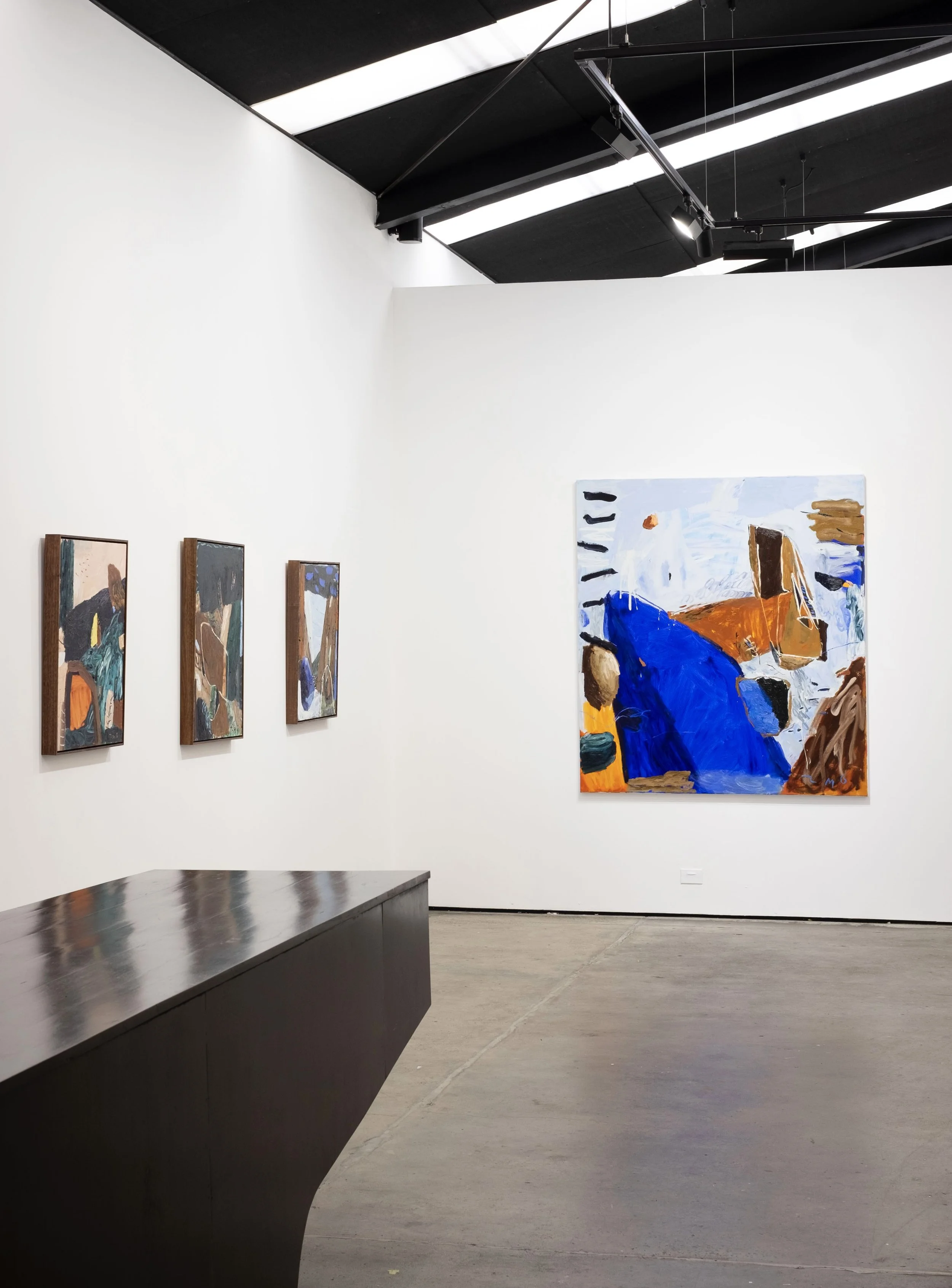
I am staring at it right now. Yeah, colours are an important part of my work, very central, I think. I guess the way I work with colour is, again, quite intuitive and less technical. My technical skills in general are not very elite in painting. I often find it hard to mix the same colour again. But, it's a lot from the landscape, the colours I choose. I’m super influenced by the orange lichen on the rocks here, or the colour of the sky at sunset or the way the grass is in summer, or pockets of this place that feel like the colour is really present and important in that experience that I'm having. That’ll often be carried through the paintings. I'm obsessed with Ultramarine blue and cobalt blue at the moment. And orange and brown. The colours are extracted or pulled from the landscape or a memory from it or an experience. But then it's also just responding to the other colours in the work as well, so it's just building itself. For example, ‘if this isn't sitting right with that, then you've got to get rid of that’. It's partly pulled from place and my experience, and partly an intuitive response to what comes before it on the canvas.
I mean, it's such a big question, why do you do art? Are you remembering experiences and transcribing them onto a canvas?
Yeah, good question. I feel like I don't often interrogate that.
Do you think that maybe we shouldn't?
I mean, I think it’s good to be honest about it, because sometimes when I'm painting, there's nothing conceptual in that moment. It's just, purely the tactility and the kind of energy and the movement of the paint that is just, luscious and delicious, and I feel like: sometimes I'm painting for the sake of paint. You know, you conceptualise it all you want, but sometimes it's just because it's something you are drawn to doing. When I'm putting together an exhibition, I’m driven to start with themes, ideas, and questions that I want to ask. I'm super interested in things and concepts behind making work, that's so important to me as well. For me, a lot of it is this place, Marrawah. It’s endlessly inspiring to me, and trying to capture parts of this place and my experience of it, or my relationship to it or sort of understanding it through painting as well. It's also part of what I do and who I am. I'm an artist and painter, and I really love doing it for a job. I find it really fulfilling and challenging. It's pretty amazing. It feels productive.
I'm really excited to see your show at Despard Gallery, ‘Out Of The Blue’ and the words on your recent artworks. What themes are you exploring in this show?
It's a lot about home, Marrawah and this place. But it’s a much more personal show in what it’s responding to. My mum passed away a year and a half ago. So this show has been a way of healing, processing grief, remembering her and paying tribute to her and asking through making a show: how place can also be a space for healing and how that's played a role in my grief; being in Marrawah and the ocean and the landscape. All the parts of this place that I've painted for this show, remind me of her. She showed me them. So it’s been kind of a hectically emotional, but also deeply cathartic body of work. The words are of these poems that I've been writing about her, or feeling. It was dawning on me that this is a bit more vulnerable than I probably usually have been, showing my work.
I’m sure it’s going to be amazing. What a way to remember such an important person in your life. Was she an artist?
No, she wasn't. My dad and my brother surf, that’s a big thing. My mum was a massive reader and I feel like my love of words has come from there. We were just tight and I feel like the studio has also been this little grief temple for me to go to and make work thinking about her, or distracting myself there. So, the show's quite emotional, but like everything, a lot of joy and light as well, I hope.
So beautiful. What a beautiful way to move through grief, through art.
Yeah, I think I probably felt pretty grateful for my practice through going through something so awful. When it wasn’t feeling possible to paint, writing has kind of stepped up as an outlet. I think we're really lucky as artists to have an outlet or way to process. Our practices can help us reflect and process things. We’re so lucky to be able to do that. I feel super grateful for that.